Tech Giants Envision a Future Beyond Smartphones: What Comes Next?
For more than a decade, smartphones have been at the center of our digital lives. We use them to communicate, navigate unfamiliar places, manage money, watch videos, work remotely, and access artificial intelligence. Yet some of the world’s biggest technology companies are exploring a different future—one in which people rely less on handheld screens and interact with digital services in more natural ways.
Artificial intelligence (AI), smart glasses, wearable devices, and spatial computing are opening new possibilities for personal technology. Instead of constantly reaching for a phone, users may eventually receive directions through glasses, ask an AI assistant to summarize information, or interact with digital content in their physical surroundings.
This does not mean smartphones are about to disappear. The more realistic possibility is that computing will spread across several connected devices, with the phone gradually sharing its role with new interfaces.
So, what are technology companies actually building, why are they pursuing these alternatives, and what obstacles could prevent them from becoming mainstream? Here is a closer look at the technologies shaping the next phase of personal computing.
Why Are Tech Giants Looking Beyond Smartphones?
Smartphones remain extremely useful, but the industry has entered a more mature phase. Many users already own capable devices that handle everyday tasks well, making some annual upgrades feel less significant than earlier technological leaps.
At the same time, companies are looking for new ways to deliver digital services. A device that people wear throughout the day or an AI assistant that can respond to its surroundings could create new opportunities for software, communication, and digital experiences.
Several factors are driving this shift.
1. Artificial Intelligence Is Changing How People Interact With Technology
Traditional smartphone interfaces depend heavily on apps, menus, tapping, and typing. AI assistants can make some tasks more conversational and less dependent on manually navigating multiple applications.
For example, a user might ask an assistant to summarize a long document, identify an object, translate a conversation, or organize information. As AI systems improve, more tasks could be completed through voice, contextual assistance, or a combination of voice and visual controls.
The important distinction is that AI does not automatically eliminate the need for a screen. Complex editing, detailed research, and financial transactions may still be easier to complete on a phone or computer. AI is more likely to change how users access services than to remove every existing interface.
2. Smartphone Innovation Is Becoming More Incremental
Modern phones already offer high-resolution cameras, fast processors, advanced connectivity, and sophisticated applications. Improvements continue, but many everyday activities remain similar from one generation to the next.
Technology companies therefore have an incentive to explore new product categories rather than compete exclusively through better displays or faster processors.
A successful new interface could also establish a platform for applications, subscriptions, accessories, and services. That possibility helps explain why companies are experimenting with wearable computing and AI-powered devices.
3. People Want More Convenient Digital Experiences
Using a phone can interrupt an activity. A driver may need to glance at a navigation display, a traveler may repeatedly open a translation app, and a technician may need both hands to complete a repair.
Hands-free or context-aware technology could make these activities easier. However, convenience must be balanced with safety, privacy, comfort, and the ability to control when a device responds.
The next generation of personal technology will succeed only if it solves practical problems better than existing devices.
The Technologies That Could Shape the Future Beyond Smartphones
There is no single device that has definitively replaced the smartphone. Instead, several technologies are developing in parallel, each suited to different tasks.
1. AI-Powered Smart Glasses
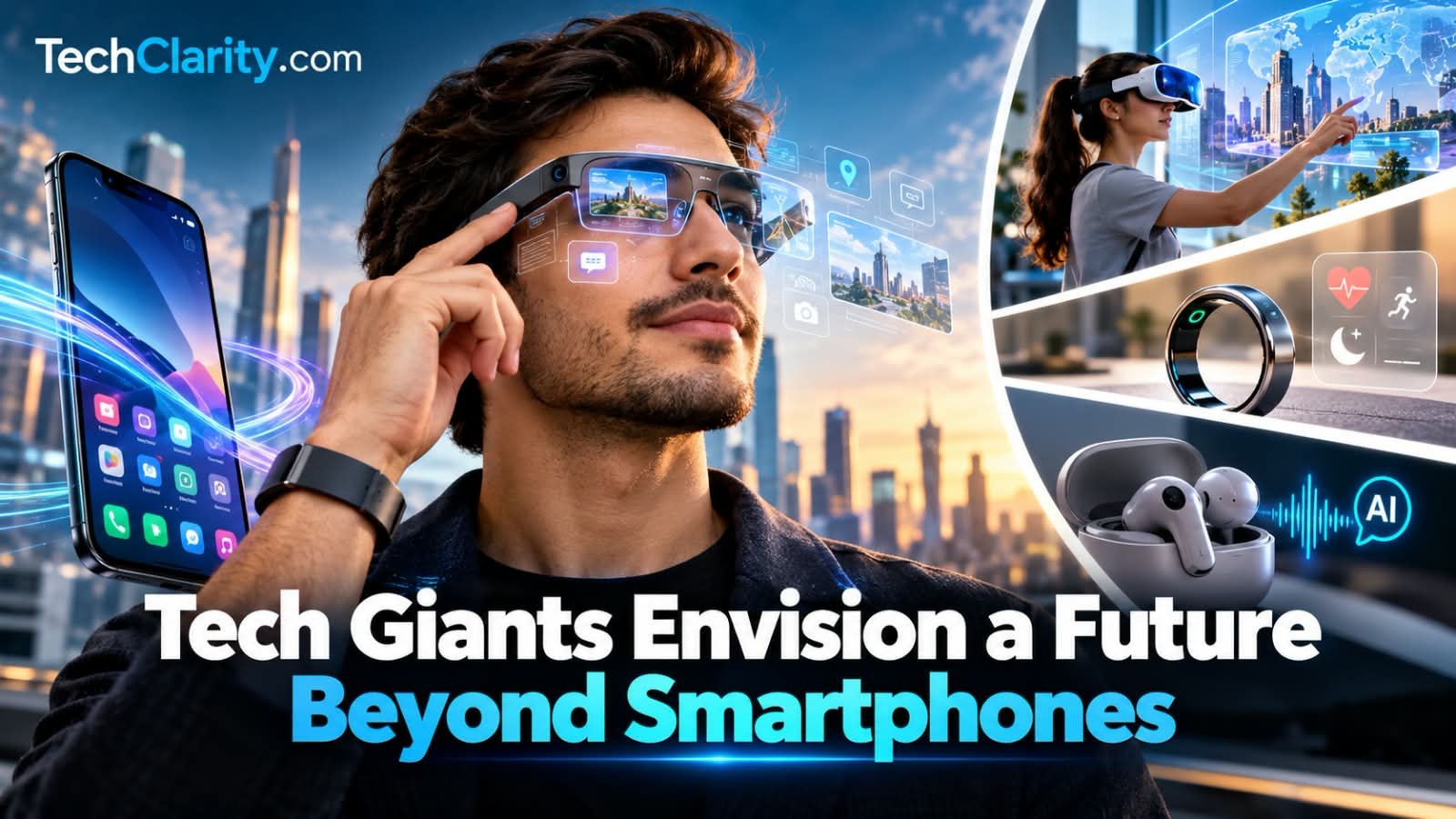
Smart glasses are among the most visible examples of computing moving away from handheld screens. Depending on the model, they can incorporate cameras, microphones, speakers, wireless connectivity, and AI assistants into an eyewear-style design.
Meta has developed AI glasses through its Ray-Ban partnership and introduced the Meta Ray-Ban Display in September 2025. The company described the product as featuring an integrated display and a wristband that interprets subtle muscle signals for input.
This illustrates an important direction: technology does not always need to look like a conventional computer to provide useful digital functions.
Potential applications include:
- Hands-free assistance: Ask an AI assistant a question while cooking, walking, or working.
- Visual information: Use a camera to help identify objects or understand unfamiliar surroundings.
- Communication: Listen to messages or interact with compatible communication services.
- Translation: Receive language assistance during travel or conversations, where supported.
- Navigation: Access directions without repeatedly looking down at a phone.
Not all glasses offer every feature, and capabilities depend on the model, software, connectivity, and region.
The biggest challenge is making them comfortable, affordable, useful, and socially acceptable. Devices that record audio or video also need clear privacy safeguards, particularly when other people are nearby.
2. Augmented Reality and Spatial Computing
Augmented reality (AR) places digital information over a view of the physical world. Spatial computing is a broader approach that allows digital objects and interfaces to be positioned and manipulated within a three-dimensional environment.
Imagine an engineer examining a machine while viewing digital instructions beside a component. A student might explore a three-dimensional model, while a designer could inspect a virtual prototype at a realistic scale.
These experiences can be delivered through different types of hardware, including headsets and certain glasses. They do not all require the same capabilities, and a simple smart-glasses interface is not equivalent to a full spatial-computing system.
Potential uses include:
- Product design and visualization
- Technical training and equipment maintenance
- Immersive educational experiences
- Virtual collaboration
- Three-dimensional entertainment and gaming
The main barriers are cost, weight, battery life, visual comfort, and the availability of applications that provide enough value to justify purchasing additional hardware.
For many users, spatial computing will initially complement a smartphone or computer rather than replace either one.
3. AI Assistants That Understand Context
AI assistants could become an increasingly important part of the next computing era. Instead of requiring users to open a particular app for every task, assistants may help connect information and actions across supported services.
Google’s Android XR initiative, announced in partnership with Samsung and Qualcomm in December 2024, demonstrates this direction. Google presented the platform as a foundation for next-generation headsets and glasses, combining extended-reality experiences with AI capabilities.
A context-aware assistant could eventually help a traveler understand a sign, explain an object in view, or provide information relevant to a task. More advanced systems may combine speech, visual input, and information supplied by compatible applications.
However, context-aware AI is not the same as perfectly reliable AI. Systems can misunderstand instructions, misidentify objects, produce incorrect answers, or fail when connectivity is limited.
Users will still need ways to verify important information, review actions, manage permissions, and prevent an assistant from accessing information unnecessarily.
4. Wearables Beyond Glasses
Smartwatches, wireless earbuds, fitness bands, and smart rings show that people are already comfortable using some technology without holding a phone.
These devices are especially useful for tasks that benefit from quick access or continuous sensing.
For example, a smartwatch can display notifications, track activity, and provide certain health-related measurements. Earbuds can support calls, audio playback, and voice interactions. Some wearable devices can also provide AI features when connected to compatible services.
Their strengths are convenience and specialization. A small wearable does not need to reproduce every function of a smartphone to be useful.
In the future, multiple devices could work together: a watch handles brief notifications, glasses provide visual assistance, earbuds manage audio, and a phone remains available for tasks requiring a larger screen.
This distributed approach may prove more practical than expecting one new gadget to perform every function.
5. Ambient Computing and Connected Environments
Ambient computing describes technology that operates in the background and responds to a user’s needs without requiring constant direct interaction.
Examples already exist in smart homes, connected vehicles, and voice-controlled environments. Lights can respond to automation rules, speakers can answer questions, and compatible devices can coordinate certain tasks.
Future systems may connect more of these capabilities with AI. A user could potentially move between home, work, and a vehicle while accessing consistent assistance through different devices.
However, ambient computing depends on reliable connectivity, compatible products, secure accounts, and carefully configured permissions. A system that works only within one company’s ecosystem may be less convenient when users own devices from different manufacturers.
Interoperability will therefore play an important role in determining whether these environments become genuinely useful.
6. Brain-Computer Interfaces
Brain-computer interfaces (BCIs) are a more experimental direction. They aim to translate signals associated with brain activity into commands that a computer can interpret.
Some invasive systems are being investigated for medical applications, including helping people with severe movement limitations interact with digital devices. These technologies are fundamentally different from ordinary consumer wearables because some require surgical implantation and specialized medical oversight.
The potential benefits for people with certain disabilities are significant. However, medical progress should not be confused with evidence that healthy consumers will soon control everyday phones entirely through thought.
Safety, reliability, long-term effects, regulatory approval, data protection, and ethical questions remain central concerns. Consumer-scale brain implants are not a necessary step for the future of personal computing, and their widespread adoption cannot be assumed.
How Major Technology Companies Are Approaching the Next Era
Different companies are pursuing different parts of the emerging ecosystem. Their strategies overlap, but their products should not be treated as interchangeable.
Meta: Making AI Glasses More Practical
Meta’s work on AI glasses combines an established eyewear format with cameras, audio, and AI-powered features. Its Meta Ray-Ban Display announcement in 2025 also demonstrated an approach that adds a visual display and an alternative input method.
The strategy focuses on bringing digital assistance into an object people can wear during ordinary activities.
Its success will depend on practical features, attractive designs, battery performance, user trust, and responsible handling of camera and microphone data.
Google: Extending Android Into XR
Google’s Android XR initiative is designed to support extended-reality devices, including headsets and glasses. The company announced the platform in collaboration with Samsung and Qualcomm in December 2024.
The approach builds on Google’s experience with Android and AI, while involving partners in hardware development.
A platform strategy can help developers build applications for multiple compatible devices. At the same time, the ecosystem must deliver consistent performance, useful applications, clear privacy controls, and a good experience across different hardware designs.
Apple: Exploring Spatial Computing
Apple has used the term spatial computing to describe experiences that combine digital content with the physical environment. Its Vision Pro headset is an example of this approach.
Spatial computing offers opportunities for immersive entertainment, productivity, communication, and three-dimensional interaction. It also faces practical constraints associated with head-mounted devices, including cost, comfort, battery arrangements, and whether people have enough reasons to use them regularly.
Apple’s broader ecosystem could be relevant to how its devices work together, but the long-term role of spatial computing in everyday consumer life remains an open question.
Samsung and Qualcomm: Supporting the Hardware Ecosystem
Samsung and Qualcomm are collaborators in Google’s Android XR initiative. Their participation highlights the importance of both device manufacturing and the underlying processors that power emerging interfaces.
Wearable and extended-reality devices need to balance computing performance with heat, size, weight, energy consumption, and wireless connectivity.
Progress in these areas can make new form factors more practical, although better hardware alone does not guarantee widespread adoption. Software quality and clear consumer benefits remain equally important.
Neuralink and Other BCI Developers
Brain-computer interface developers are pursuing a very different goal from companies making glasses or headsets. Their research focuses on translating neural signals into computer commands, with some systems being investigated for people with significant medical needs.
This field could influence how certain users access computers, but it should be viewed separately from the more immediate development of consumer wearables.
For now, smart glasses, watches, phones, and conventional AI interfaces are much more practical reference points for everyday technology than elective brain implants.
Smartphones vs. Emerging Devices: What Is the Difference?
| Technology | Main strength | Key limitation |
|---|---|---|
| Smartphones | Versatile, familiar, and supported by mature apps | Requires handheld screen interaction for many tasks |
| Smart glasses | Hands-free access to selected digital features | Battery, privacy, comfort, and feature limitations |
| AR/XR headsets | Immersive visual and spatial experiences | Cost, weight, and extended-use comfort |
| Smartwatches and earbuds | Convenient access to specific functions | Small interfaces and dependence on compatible services |
| Ambient AI systems | Background assistance across connected environments | Reliability, permissions, interoperability, and privacy |
| Brain-computer interfaces | Potential alternative input for specific medical needs | Invasiveness for some systems and substantial technical and regulatory challenges |
No category wins in every situation. The best device depends on the task, the user’s needs, and how reliably the technology works.
What Could Everyday Life Look Like Without Constant Phone Use?
Consider a typical day in which several devices work together.
In the morning, a wearable assistant provides a brief schedule summary. During a commute, compatible glasses offer navigation or information without requiring repeated interaction with a handheld display. At work, an AI assistant summarizes a document, while a computer remains available for detailed editing.
Later, a connected home system manages configured routines, and a smartwatch displays a short notification. The user still has a smartphone available for banking, messaging, photography, and tasks that require a familiar app.
This scenario does not depend on one futuristic product doing everything. It depends on several technologies working together reliably.
The most useful changes may be relatively small: fewer unnecessary screen interactions, faster access to relevant information, and more convenient ways to complete specific tasks.
The real measure of progress will be whether these tools make daily activities easier without introducing more distractions or complexity.
The Biggest Challenges Facing a Post-Smartphone Future
Promising technology does not automatically become a successful consumer product. Several challenges could determine how quickly these devices become part of everyday life.
Privacy and Data Security
Cameras, microphones, location services, and AI systems can collect sensitive information. Devices worn throughout the day may capture details about both the wearer and the people around them.
Manufacturers need transparent data policies, meaningful permission controls, secure storage and transmission, and understandable indicators when recording is active.
Users should be able to determine what information a device collects, where it is processed, how long it is retained, and whether it can be deleted.
Battery Life and Comfort
A smartphone has room for a relatively large battery. Glasses and other compact wearables have much tighter limits on size, weight, heat, and power consumption.
High-performance processing and displays can increase energy demands. Manufacturers must therefore balance features against runtime and comfort.
A device that needs constant charging or becomes uncomfortable after an hour may struggle to become part of a user’s daily routine.
Cost and Accessibility
New hardware can be expensive, especially during its early development. Consumers must decide whether the benefits justify buying another device when their existing phone already handles most tasks.
Accessibility also matters. Devices should account for different visual, hearing, mobility, and communication needs, as well as affordability across different markets.
A technology that is useful only to a small group of wealthy early adopters will have a different impact from one that is practical for a broad audience.
Social Acceptance
People may be uncomfortable around cameras or microphones worn by others, even when recording is not taking place. Wearing a headset in public can also be inconvenient or socially awkward.
Manufacturers need to consider the experience of bystanders as well as device owners. Clear recording indicators, respectful defaults, and rules for sensitive environments can help establish trust.
Reliability and Dependence on AI
AI systems can make errors, misunderstand context, and struggle with unusual situations. Voice interfaces may also be inconvenient in noisy environments or when users need privacy.
For critical tasks, people need clear confirmation steps, ways to correct mistakes, and access to conventional interfaces when automated assistance fails.
The most successful systems are likely to combine automation with user control rather than expecting people to trust every decision an AI makes.
Will Smartphones Disappear Completely?
A complete replacement is unlikely to happen overnight. Smartphones benefit from mature operating systems, established application ecosystems, powerful cameras, mobile connectivity, and familiar interaction patterns.
They also provide a useful fallback when a wearable has a small display, limited battery capacity, or restricted features.
A more plausible transition is gradual. Wearables and AI assistants may take over selected tasks while phones continue to handle activities that need detailed visual information, extensive typing, or precise controls.
Some users may eventually rely less on their phones, while others may prefer traditional devices. Adoption will vary according to price, geography, occupation, accessibility needs, and personal preference.
Rather than predicting a specific year when smartphones become obsolete, it is more useful to watch for practical signs of change: devices people use regularly, applications that solve real problems, improved battery life, reliable AI assistance, and strong privacy protections.
What Should Consumers Expect Next?
The next phase of personal computing will likely involve several technologies developing at different speeds.
Smart glasses and other wearables can provide immediate value when their functions are focused and convenient. AI assistants may gradually simplify certain interactions across phones, computers, and connected devices. Spatial computing can offer specialized benefits in work, education, and entertainment.
Brain-computer interfaces remain a separate, more specialized field, particularly where invasive medical systems are involved.
Consumers do not need to abandon their current phones to participate in these changes. Before buying a new device, consider its everyday usefulness, supported applications, battery life, comfort, repair options, privacy settings, and compatibility with existing products.
The strongest products will be those that solve a real problem—not simply those that promise a more futuristic experience.
Frequently Asked Questions
What does a future beyond smartphones mean?
It describes a possible shift toward using multiple connected devices, such as smart glasses, wearables, AI assistants, and spatial-computing systems, instead of relying on a smartphone for every digital task. It does not necessarily mean phones will disappear.
Which technologies could reduce smartphone use?
AI-powered smart glasses, voice assistants, smartwatches, earbuds, ambient computing, and certain spatial-computing devices could handle specific tasks that currently require a phone. Their usefulness depends on available features, reliability, and user needs.
Are smart glasses going to replace smartphones?
Not completely in the near future. Smart glasses can provide hands-free assistance and selected visual or audio features, but most models do not offer the full range of functions available on a smartphone. They are more likely to complement phones initially.
How will artificial intelligence change personal devices?
AI can help users summarize information, answer questions, interpret visual input, translate language, and perform supported tasks through conversational interfaces. Its impact will depend on accuracy, privacy safeguards, integration with applications, and how much control users retain.
What is spatial computing?
Spatial computing allows digital content and interfaces to interact with a three-dimensional environment. It can support immersive entertainment, design, training, and collaboration through compatible headsets and other devices.
Can people control devices directly with their thoughts?
Brain-computer interfaces are being researched and developed for specific uses, including helping some people with severe disabilities interact with computers. This does not mean thought-controlled consumer devices are ready to replace smartphones for the general public.
What are the main risks of wearable AI?
Important risks include privacy violations, unauthorized recording, insecure data, inaccurate AI responses, limited battery life, high costs, and social discomfort. Strong privacy controls and transparent device behavior are essential.
Should I wait for a new device instead of buying a smartphone?
Most consumers do not need to wait. Smartphones remain practical and versatile. Consider an emerging device only if its current features solve a specific problem you experience and its price, privacy protections, and limitations make sense for you.
Final Thoughts
The next chapter of personal technology may be less about carrying a more powerful phone and more about choosing how and when digital services reach us.
AI assistants, smart glasses, spatial computing, and other wearables are creating new ways to access information and interact with digital environments. Each has potential, but each also faces practical limitations.
The most realistic future is not necessarily one without smartphones. It may be a world in which phones share their role with a network of useful, connected devices—and where technology becomes more convenient without becoming more intrusive.
For consumers, the key question is simple: does a new interface make life genuinely easier, safer, and more accessible? The answer will determine which technologies become everyday essentials and which remain niche experiments.